



 English
A Cam washer is a precision metal component used in cam hinge and rotary shaft systems to control rotation, positioning, automatic closing, and return movement. It is normally designed to work together with a matching concave cam washer to create a controlled torque curve during rotation.
Although a Cam Washer is a relatively small component, its surface profile, dimensional accuracy, material, and hardness can directly affect the operating feel, positioning performance, and service life of the entire hinge assembly.
If you would like to understand the matching component first, read our related guide:Cam Washer Design and Applications.
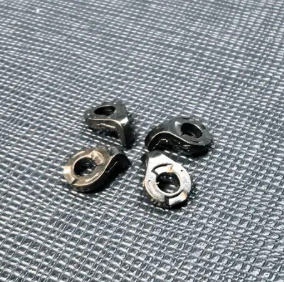
What Is a Cam Washer?
A Cam Washer is a specially formed Metal Washer with a raised 3D cam surface. Unlike a conventional Flat Washer, its primary purpose is not simply to distribute clamping force. Instead, the raised cam profile interacts with a corresponding concave surface to create controlled mechanical movement.
As the hinge rotates, the convex surface moves along the recessed profile of the mating washer. This changes the contact position and axial force between the two components.
This mechanism can be used to achieve:
Automatic closing
Automatic return
Angle positioning
Controlled opening resistance
Stable hinge torque
How Does a Cam Washer Work?
A Cam Washer normally works as part of a cam washer pair. One component has a raised surface while the matching component has a corresponding recessed surface.
During rotation, the two profiles slide against each other. Because the height of the cam profile changes according to the rotation angle, the axial compression force also changes.
The basic working principle can be summarized as:
Rotation → Cam contact → Axial movement → Force variation → Torque change → Positioning or automatic return
By carefully controlling the cam geometry, engineers can design a hinge with a specific torque curve instead of relying only on constant friction.
Cam Washer vs Concave Cam Washer
| Feature | Cam WasherConcave Cam Washer | |
|---|---|---|
| Surface profile | Raised 3D cam surface | Recessed 3D cam surface |
| Function | Works with the matching cam surface | Works with the matching cam surface |
| Application | Cam hinges and rotary mechanisms | Cam hinges and rotary mechanisms |
| Typical use | Positioning and torque control | Positioning and torque control |
These two components should normally be considered as a matched functional pair. The geometry of one washer needs to correspond accurately with the other to achieve stable movement and predictable torque.
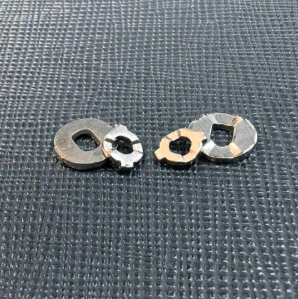
Why Is the Cam Profile Important?
The 3D cam profile is one of the most important features of a Cam Washer. Small deviations in the profile can change the contact path between the two washers.
This may result in:
Uneven hinge torque
Inconsistent opening resistance
Incomplete automatic closing
Unstable return movement
Premature surface wear
Different performance between production batches
For this reason, precision forming and accurate tooling are essential when manufacturing Cam Washers for high-performance hinge systems.
What Materials Are Used for Cam Washers?
Cam Washers are commonly manufactured from carbon steel and other materials suitable for precision stamping and heat treatment. Materials such as SK5 and SK7 can be used when a balance between strength, wear resistance, and formability is required.
The final material selection depends on the load, operating frequency, required service life, and environment of the hinge.
Why Is Heat Treatment Important?
A cam washer is repeatedly exposed to contact pressure and friction during operation. Without suitable hardness, the raised cam surface may gradually wear and change the original torque characteristics.
Heat treatment improves surface hardness and wear resistance, helping the cam washer maintain more stable performance over repeated cycles.
However, excessive hardness is not always better. If the material becomes too brittle, it may be more susceptible to cracking during forming or long-term operation.
Therefore, hardness should be selected according to the material, cam geometry, mating washer, load, and expected cycle life.
How Is a Cam Washer Manufactured?
Manufacturing a precision Cam Washer normally involves several processes.
Material preparation
Precision stamping
Cam surface forming
Hole and positioning feature forming
Heat treatment
Surface treatment
Dimensional inspection
The forming process is particularly important because the 3D cam profile must remain consistent across large production quantities.
What Should Be Checked During Quality Control?
For precision cam washers, manufacturers should pay close attention to the following dimensions and characteristics:
Inner hole diameter
Outer diameter
Washer thickness
Cam height and profile
Surface flatness
Concentricity
Symmetry
Positioning ear dimensions
Heat treatment hardness
Surface treatment quality
These parameters work together to determine whether the finished washer can maintain consistent performance when installed in a high-cycle hinge.
Where Are Cam Washers Used?
Cam Washers are commonly used in mechanical systems that require controlled rotation or positioning.
Laptop hinges
Monitor hinges
Foldable electronic devices
Automotive display hinges
Cabinet and enclosure mechanisms
Industrial rotary mechanisms
Precision mechanical hinges
They are particularly useful when the product requires more than simple rotational friction and needs a specific movement pattern or automatic return function.
How to Choose the Right Cam Washer
Selecting a Cam Washer requires consideration of the complete hinge assembly rather than the washer alone.
1. Check the Installation Space
Confirm the available inner diameter, outer diameter, thickness, and axial installation space before selecting the washer.
2. Match the Concave Washer
The convex cam profile must be compatible with the mating concave cam washer. A mismatched pair may cause excessive friction, unstable torque, or poor automatic return.
3. Define the Required Torque
The target torque and torque curve should be established during the hinge design stage. Different cam profiles can create different resistance characteristics at different opening angles.
4. Consider Service Life
For products that are opened and closed thousands or even tens of thousands of times, wear resistance and hardness should be carefully evaluated.
5. Select the Appropriate Surface Treatment
Surface treatment should be selected according to the operating environment, including humidity, temperature, corrosion exposure, and expected service life.
How Does a Cam Washer Affect Hinge Performance?
The performance of a cam washer is closely related to the final operating feel of the hinge.
A properly designed cam profile can provide a controlled torque curve, allowing the product to open smoothly, remain stable at specific angles, and return automatically when required.
In contrast, poor dimensional consistency can cause significant variation between individual hinges, even when the overall assembly dimensions appear correct.
This is why precision manufacturing is particularly important for cam washers used in consumer electronics and other high-cycle applications.
Why Choose a Professional Cam Washer Manufacturer?
Producing a reliable Cam Washer requires experience in precision stamping, forming, heat treatment, surface treatment, and dimensional inspection.
For customized applications, a professional manufacturer can also adjust the cam profile, dimensions, material, hardness, and surface treatment according to the customer's required torque and operating conditions.
For more information about precision Hinge Components and related washer technologies, you can also read:How to Install a Conical Washer.
Conclusion
A Cam Washer is a functional precision component designed to work with a matching concave cam washer. Through their specially formed 3D surfaces, the two components can control torque, positioning, automatic closing, and return movement in a hinge system.
For reliable performance, engineers should consider cam geometry, dimensional accuracy, material, heat treatment, surface treatment, and service life as one complete system.
For manufacturers developing customized hinges or rotary mechanisms, working with an experienced cam washer manufacturer can help optimize both performance and production consistency.