



 English
Fasteners are the parts nobody designs around until something comes loose. A custom fastener looks like a commodity item, but the moment your assembly needs a specific grip length, a particular head, a defined locking behaviour or a corrosion class that the catalogue does not stock, you are buying an engineered part — and the supplier you choose decides whether it performs.
This guide is for buyers and engineers sourcing custom Bolts, screws and lock nuts, with a focus on sourcing from China. It covers how fasteners are made, what to specify on a drawing, how locking mechanisms actually work, and how to tell a real custom fastener manufacturer from a distributor with a catalogue.
In practice, that means choosing a custom fastener manufacturer who runs parts to your drawing rather than to a catalogue page. Whether you need a custom bolts manufacturer, a custom screws manufacturer or a Top Lock Nut manufacturer, the questions are the same — and so are the mistakes buyers make when they skip them.
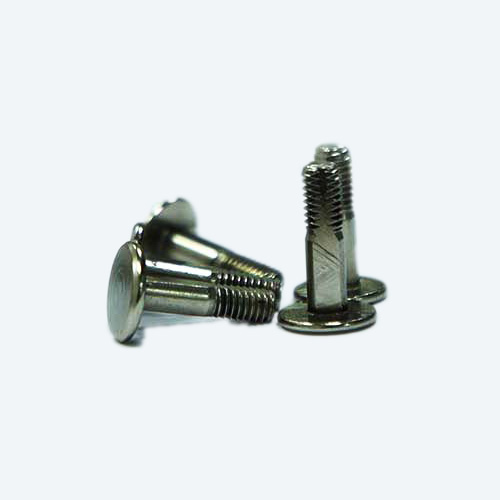
Custom bolts — flat-head and shoulder designs made to drawing
What Counts as a Custom Fastener
A fastener is custom when the standard catalogue will not do. That usually means one or more of the following is outside the common range:
- Non-standard dimensions — an unusual diameter, pitch, length or head geometry.
- A specific material or finish — a stainless grade, a plating class, or a coating chosen for a particular environment.
- An integrated feature — a shoulder, a captive washer, a knurl, a slot or a tamper-resistant drive.
- A defined locking behaviour — a nut that must hold a set torque after thousands of cycles, or resist vibration without a separate Washer.
- A mating requirement — the fastener has to pair with a specific stamped washer or hinge component in your assembly.
When two or more of these apply, you are no longer buying from a catalogue. You are buying a drawing, and the supplier's job is to hold it.
Bolts, Screws and Lock Nuts: Getting the Terms Right
Purchasing and engineering often use these words loosely, and the confusion costs time on the shop floor. The practical distinction is how the fastener is driven and how it is loaded:
- Bolts are generally driven with a nut and loaded in tension; they usually have a machine thread and a defined strength grade.
- Screws thread directly into the mating part or a tapped hole, and are often smaller and lighter-duty.
- Lock nuts are designed to resist loosening, either through a deformed thread section, a nylon insert, a serrated flange or a prevailing-torque feature.
For a stamped assembly — a hinge, a bracket or a washer stack — the bolt carries the clamp load and the lock nut holds it. If you specify only one of the two, you have specified half the joint. This is why it helps to buy them together from a supplier who understands both.
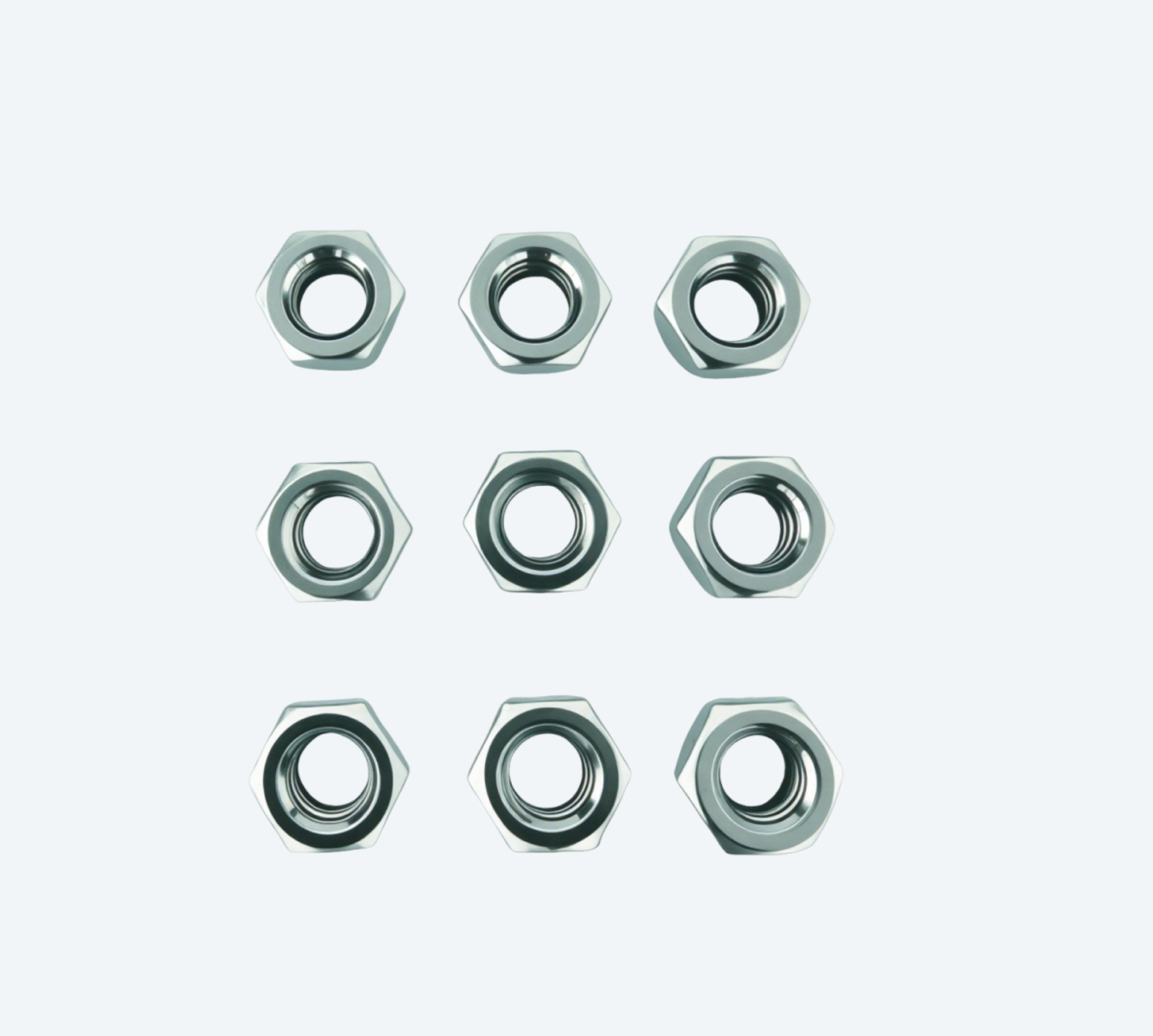
Custom lock nuts — prevailing-torque designs for vibration-resistant joints
Materials and Finishes for Custom Fasteners
Material sets the strength and the corrosion behaviour; the finish fine-tunes it and controls appearance. The table below covers the common combinations for custom work:
| Material | Typical use | Common finish | Notes |
|---|---|---|---|
| Carbon steel (grade 4.8 / 8.8 / 10.9) | General structural and mechanical joints | Zinc, zinc-nickel, black oxide | Cheapest; strength set by grade, corrosion protection by plating |
| Stainless steel 304 | Outdoor, food and wet environments | Passivated, plain | Good corrosion resistance; not ideal for high-strength joints |
| Stainless steel 316 | Marine and chemical exposure | Passivated, plain | Better chloride resistance than 304 |
| Alloy steel (grade 12.9) | High-strength joints | Black oxide, zinc-nickel | Needs care to avoid hydrogen embrittlement after plating |
| Brass | Electrical and decorative applications | Nickel-plated, plain | Non-magnetic, conductive, corrosion-resistant |
Two cautions worth repeating. First, a coating that is specified for appearance is not automatically a coating specified for corrosion — say which problem you are solving. Second, high-strength plated steel can suffer hydrogen embrittlement if the plating and baking cycle is wrong, which is why grade 12.9 parts deserve a supplier who understands the process, not just the part.
Threads and Standards: What to Specify
Thread specification is where most custom fastener disputes start. On a drawing you need, at minimum: thread system (metric or inch), nominal diameter, pitch, tolerance class, and thread length. "M6" alone is not a specification — M6 with a 1.0 mm pitch and M6 with a 0.75 mm pitch are different parts, and the coarse version will not go where the fine one was designed to fit.
Metric is the default for most new industrial designs, and ISO 965 defines the tolerance classes. Inch threads still appear in equipment with North American lineage, and mixing the two in one assembly is a reliable way to strip something. If your product ships into a market that expects one system, specify it explicitly and hold the supplier to it.
Also decide whether threads are rolled or cut. Rolled threads are stronger because the grain flow is continuous, and they are the norm for high-volume custom fasteners. Cut threads are used where the geometry prevents rolling. A supplier who cannot tell you which method they use for your part is not the supplier you want.
How a Lock Nut Actually Stays Tight
Vibration loosens fasteners because the joint loses preload, not because the nut spontaneously rotates. A lock nut works by keeping a prevailing torque even after the initial clamp load relaxes. The common designs each solve it differently:
- Nylon-insert lock nuts — a nylon collar grips the thread. Simple and effective, but limited by the nylon's temperature ceiling.
- All-metal prevailing-torque nuts — a deformed thread section creates friction along the whole engagement. Works hot, and is the usual choice for high-temperature or high-reliability joints.
- Serrated flange nuts — teeth bite the mating surface to resist rotation. They need a hard, flat mating face to work.
- Jam nuts — a second thin nut locked against the first. Cheap, but sensitive to how well it is set.
The choice depends on temperature, the hardness of the mating surface, and how often the joint is serviced. If your assembly is safety-related or subject to heavy vibration, specify the locking mechanism and the prevailing torque it must hold, rather than just asking for a "lock nut". A custom lock nut manufacturer should be able to quote that prevailing torque and test it on the finished part. Our top lock nut range covers the all-metal designs that hold up under vibration.
Tooling: Cold Heading Versus Machining
Custom fasteners are produced by two very different routes, and the route decides both cost and lead time:
Cold heading forms the head and shank by upsetting wire in a die. It is fast, produces almost no waste, and is the standard for high-volume bolts and screws. The trade-off is tooling: each head and shank shape needs its own die, so cold heading only pays off above a volume threshold.
Machining cuts the fastener from bar stock, one part at a time. It needs no dedicated tooling and handles complex geometry and small batches, but the unit cost is far higher and material waste is significant.
For most custom work, the sensible path is to machine the prototype, confirm the design, then move to cold heading for production. A supplier who can do both under one roof will tell you where the crossover point sits for your part instead of pushing one process for every order. The same logic applies to the stamped parts that pair with the fasteners — a flat washer under a bolt head is usually a stamped part, not a machined one.
Strength, Grade and Load Ratings
Strength grade is not decoration. A grade 8.8 bolt and a grade 12.9 bolt of the same size look identical and behave very differently under load. If your joint is designed to a clamp load, the grade is part of the specification, and the supplier must be able to prove it.
| Grade | Nominal tensile strength | Typical material | Common application |
|---|---|---|---|
| 4.8 | 400 MPa | Low-carbon steel | Light-duty, non-structural joints |
| 8.8 | 800 MPa | Medium-carbon alloy steel | General machinery and structures |
| 10.9 | 1,000 MPa | Alloy steel, quenched and tempered | High-strength joints |
| 12.9 | 1,200 MPa | Alloy steel, quenched and tempered | Maximum-strength joints |
| A2-70 / A4-80 | 700 / 800 MPa | Stainless steel 304 / 316 | Corrosive environments |
Ask for the material grade and, where it matters, a proof-load or tensile test on the finished part. Plating can reduce the strength of high-grade steel if the baking cycle is wrong, so a test on the finished, plated part is more meaningful than a test on raw material. For safety-critical joints, the documentation matters as much as the part.
Quality Control and Testing
Fastener quality is about consistency across a production lot. A serious custom fastener manufacturer will control it with:
- Incoming material certificates — so a strength problem can be traced to the wire or bar.
- First-article inspection — dimensions, thread gauge and hardness on the first parts off a new tool.
- Go / no-go thread gauges — the basic check that a thread is in tolerance.
- Hardness and tensile testing — on the finished part, not just the raw material.
- Torque and prevailing-torque testing — for lock nuts, the number that actually predicts field behaviour.
If your application is regulated, ask about PPAP-level documentation up front. It is much cheaper to agree the paperwork before the tool is cut.
How to Evaluate a Custom Fastener Supplier
The questions that matter are the same ones you would ask of any engineered component supplier:
- Do they make the parts or resell them? Ask for a video of the heading or machining floor.
- Can they hold a drawing? Send a real drawing and see whether they ask about grade, thread class and finish — or just quote a price.
- Do they understand the assembly? A supplier who knows the fastener will sit under a bolt and against a washer can catch fit problems early.
- What is their testing capability? In-house hardness and torque testing shortens the feedback loop.
- How do they handle a rejected lot? The answer predicts how the next problem will go.
Because fasteners rarely ship alone, it also helps to buy them from a supplier who already makes the mating stamped parts. You can see the range on our bolts page and across the wider product catalogue.
Common Sourcing Mistakes
- Specifying by catalogue name. "M6 bolt" is not a drawing. Without grade, thread class and finish, every quote is for a different part.
- Choosing strength by price. A lower grade is cheaper and weaker; if the joint needs 10.9, a 4.8 substitute will fail.
- Ignoring the coating. Plating that looks right can still be wrong for corrosion or for embrittlement.
- Buying the nut without the bolt. The locking behaviour and the clamp load have to be designed together.
- Skipping torque testing on lock nuts. The prevailing torque is the whole point of the part — test it.
Where to Start
Custom fasteners are simple parts with a short list of things that must be right: material and grade, thread specification, finish, and — for lock nuts — the prevailing torque they must hold. Get those four onto a drawing, and a competent supplier can quote and produce the part without guesswork.
For related reading, see our guides to custom washer manufacturing and friction hinge sourcing, or browse the full technical articles archive.
If you are sourcing custom bolts, screws or lock nuts for a stamped or hinged assembly, send us your drawing with grade, thread and finish. We will tell you which process suits your volume, what the tooling involves, and what we can guarantee on the finished part.