



 English
Yes, you can make a custom washer from a flat metal disc. The process typically involves cutting, punching, or machining a flat metal blank to create the required inner diameter, outer diameter, and thickness. Depending on the material and application, manufacturers can use stamping, laser cutting, or CNC machining to produce Washers in different sizes and shapes.
Making a custom washer from a flat disc is a practical option when standard washers do not meet specific dimensional or mechanical requirements. It allows manufacturers to control the washer's dimensions, material, thickness, and surface finish.
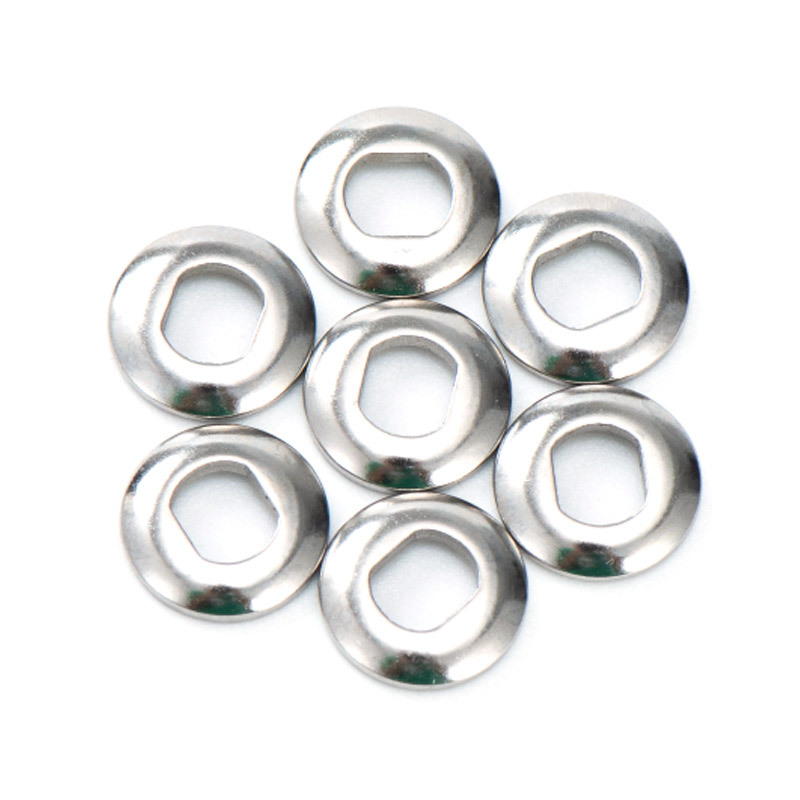
Why Make a Custom Washer from a Flat Disc?
There are several reasons to manufacture custom washers from flat metal discs:
1. Flexible Dimensions
A flat disc can be processed into different washer sizes. Manufacturers can adjust the inner diameter, outer diameter, and thickness to match specific bolt sizes and assembly requirements.
For example, an application using an M10 bolt may require a washer with a larger outer diameter to distribute the load across a wider surface.
2. Material Selection
Custom washers can be produced from stainless steel, carbon steel, copper, brass, and other metals. Each material offers different properties, such as corrosion resistance, electrical conductivity, and mechanical strength.
3. Suitable for Different Applications
Custom flat washers are commonly used in automotive assemblies, electrical equipment, machinery, construction, and industrial fastening systems.
How Is a Flat Disc Converted into a Custom Washer?
The manufacturing process generally includes the following steps:
Material Preparation: Select a metal sheet or flat disc with the required thickness and material properties.
Cutting or Punching: Create the outer profile and center hole using stamping, laser cutting, or other suitable processes.
Deburring: Remove sharp edges and burrs left by cutting or punching.
Surface Treatment: Apply coatings or finishes when corrosion resistance or other surface properties are required.
Quality Inspection: Check the inner diameter, outer diameter, thickness, and flatness against the specified tolerances.
For high-volume production, stamping is often a practical choice because it supports repeatable dimensions and faster production cycles.
What Materials Can Be Used to Make Custom Washers?
Material selection depends on the working environment, load requirements, and intended application.
Stainless Steel: Suitable for applications requiring corrosion resistance, including outdoor equipment and industrial machinery.
Carbon Steel: Commonly used in general fastening applications where mechanical strength and cost are important.
Copper: Offers good electrical and thermal conductivity, making it useful in electrical connections.
Brass: Provides corrosion resistance and electrical conductivity for selected mechanical and electrical applications.
For example, stainless steel washers are frequently selected for equipment exposed to moisture, while copper washers are used in certain sealing and electrical applications.
Is Stamping or CNC Machining Better for Custom Washers?
Both methods can manufacture custom washers, but they serve different production needs.
Manufacturing Method | Suitable Applications |
|---|---|
Stamping | High-volume production and consistent dimensions |
CNC Machining | Special dimensions and lower-volume production |
Laser Cutting | Prototypes and customized flat metal profiles |
For example, a manufacturer requiring 50,000 identical washers may benefit from stamping. For a prototype requiring only 100 pieces, laser cutting or CNC machining may be more practical.
The final choice depends on material thickness, dimensional tolerance, order quantity, and production cost.
What Dimensions Should You Provide When Ordering Custom Washers?
To manufacture a washer accurately, buyers should provide several key specifications:
Inner Diameter (ID): The diameter of the center hole.
Outer Diameter (OD): The total diameter of the washer.
Thickness: The thickness of the metal material.
Material Grade: Such as 304 stainless steel, carbon steel, or copper.
Surface Finish: Such as plain, zinc-plated, or polished.
For instance, a custom washer with a 10 mm inner diameter, 25 mm outer diameter, and 2 mm thickness has clearly defined dimensions that a manufacturer can use for production planning.
Conclusion
Making a custom washer from a flat disc is a straightforward manufacturing approach when the correct material, cutting process, and dimensional specifications are selected. Whether using stamping, laser cutting, or CNC machining, the process allows manufacturers to produce washers for different industrial and mechanical applications.
Providing accurate drawings, material specifications, and quantity requirements helps ensure that the finished custom washers meet the needs of the intended assembly.