



 English
In industrial design and precision assembly, creating stable, smooth, and durable folding and rotating mechanisms is a core requirement for products such as laptops, mobile devices, lamps, POS machines, and home appliances. A professional hinge shaft structure with high-performance washers is the key to achieving ideal damping feel, consistent torque, and long service life. This article shares a complete set of practical structure, assembly logic, and component functions based on industrial application experience, helping engineers and designers quickly optimize mechanism performance.
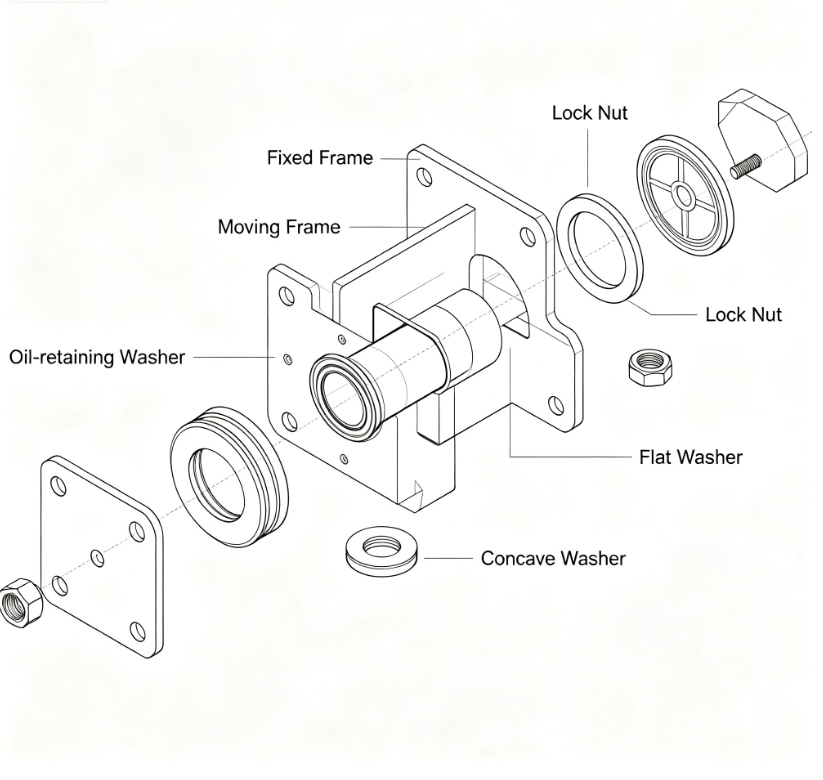
The standard hinge shaft assembly consists of six core components: fixed frame, moving frame, friction oil‑Retaining Washers, Flat Washers, spring (concave) washers, and lock nuts. Each part has a clear duty to ensure stable rotation, wear resistance, and long‑term durability.
The fixed frame serves as the stationary base, holding the central shaft steady during rotation and providing stable support for the entire structure. The moving frame is the rotating part; relative motion and friction occur between washers rather than directly on the frame body, effectively protecting structural parts from wear and extending service life.
Washers are the core to realize damping and wear resistance. Flat washers provide stable friction surfaces and load distribution, installed between the fixed frame and moving frame to form a standard friction pair. Friction oil‑Retaining Washers offer enhanced wear resistance and oil storage capacity; when the moving frame lacks sufficient hardness or heat treatment, these washers are applied on both sides to protect the base material and maintain smooth rotation.
Spring (concave) washers provide continuous axial preload pressure. Their arched structure generates elastic force after assembly, pressing the moving frame and fixed frame tightly together, maintaining consistent torque, compensating for assembly clearance and wear, and preventing loosening caused by vibration. Finally, the lock nut fixes the whole shaft; torque can be fine‑tuned by adjusting nut tightness to meet different damping requirements.
Correct assembly sequence ensures performance stability: first install a wear‑resistant flat washer on the fixed frame, then place the moving frame; add friction oil‑retaining washers if the moving frame is untreated. Install another flat washer to form a stable friction pair, then add the Spring Washer to provide preload, and lock with the nut. The entire rotation relies on washer‑to‑washer friction, protecting structural parts and achieving smooth, adjustable damping.
This structure is widely used in consumer electronics, automotive hinges, industrial equipment, furniture hardware, and smart devices. It solves problems including unstable torque, rough rotation, excessive wear, fastener loosening, short service life, and inconsistent feel after long‑term use. With proper washers, the shaft can maintain stable performance through tens of thousands of folding cycles.
As a precision hardware supplier focusing on shafts, hinges, and custom washers, Mengpeng provides flat washers, friction oil‑retaining washers, spring concave washers, and customized components to support stable, reliable, and durable rotating mechanisms. Standard and custom solutions are available for various industrial applications, helping manufacturers improve product quality and user experience.