



 English
When a standard Flat Washer will not fit, hold torque, or survive the environment it is installed in, you stop shopping for washers and start looking for a custom Washer manufacturer. The difference is not cosmetic. A custom washer is built to a drawing that defines bore shape, outer diameter, thickness, material, hardness, and surface finish — every one of which changes how the joint behaves. This guide explains how custom and special washers are specified, produced, and sourced, so you can brief a supplier with data instead of guesswork.
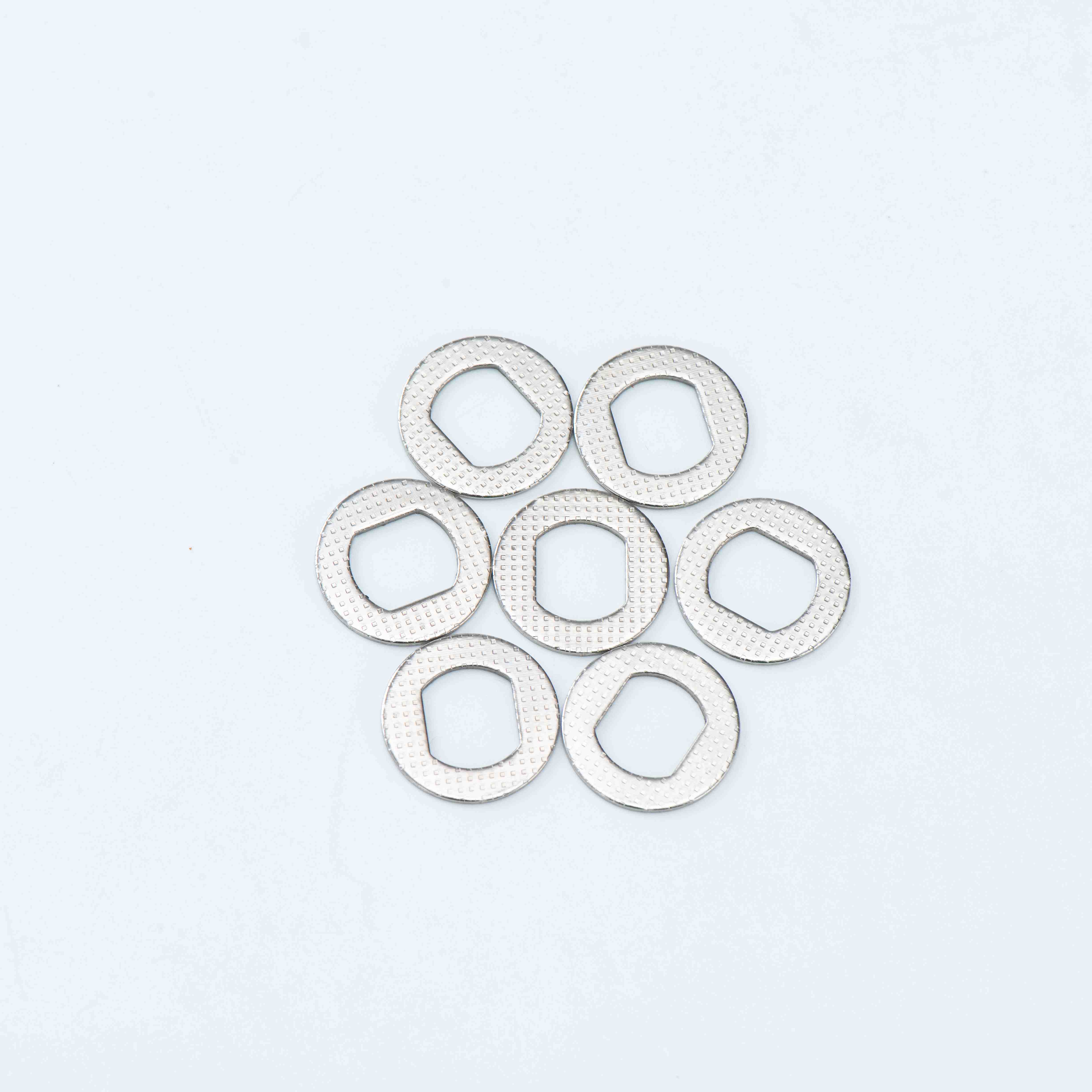
Flat washers with a D-shaped bore — a typical custom geometry stamped to a customer drawing.
What Makes a Washer "Custom" Rather Than Standard
A standard washer follows a published dimension table. You buy it by nominal size — M6, 1/4 inch, DIN 125, USS — and the tolerance bands are fixed by the standard. A custom washer breaks that table in at least one of four ways:
- Non-standard geometry. A D-shaped bore, a keyed or double-D hole, an offset hole, tabs, lugs, or a curved profile that indexes against a shaft.
- Non-standard dimensions. An outer diameter or thickness that sits between standard sizes, or a tolerance tighter than the standard allows.
- Non-standard material. Phosphor bronze, beryllium copper, 301 or 631 stainless, nylon, or a coated carbon steel chosen for a specific wear or conductivity requirement.
- Non-standard function. The washer is not there to spread load — it is there to control friction, set a rotation angle, damp vibration, or act as a bearing surface.
Once a washer carries any of these, it is no longer a catalogue item. It becomes a part, and parts are quoted from drawings. That shift is what defines the relationship with a custom washer manufacturer.
Standard, Custom, and Specialty Washers Compared
Buyers often use "custom" and "specialty" interchangeably, but they describe different sourcing situations. The table below separates them so you can tell a supplier which conversation you are having.
| Type | Definition | Typical trigger | Sourcing route |
|---|---|---|---|
| Standard washer | Matches a published standard (DIN, ANSI, JIS) | General fastening, load spreading | Catalogue, distributor, stock |
| Special washer | Standard material, modified dimensions or a simple feature | Fits a standard joint but the table does not cover it | Stamping house, short-run tooling |
| Custom washer | Built to a drawing with defined geometry, material and tolerance | New product, proprietary assembly | Custom washer manufacturer |
| Specialty washer | Function-first: friction, damping, sealing, electrical insulation | The washer is a functional component, not a fastener accessory | Specialist manufacturer with material know-how |
The practical consequence: a flat washer bought from stock costs cents and arrives in days. A specialty washer engineered into a hinge or a shaft assembly is quoted, sampled, and validated — and it usually determines whether the finished product feels tight or loose.
When a Standard Washer Stops Working
There are predictable points where the standard catalogue runs out. Watch for these signals:
- Slip under torque. The joint loosens because the washer cannot generate enough friction. A friction washer with a defined surface texture or a hook washer that keys into the mating part solves what a plain flat washer cannot.
- Rotation angle is uncontrolled. Products that must open to a set angle and stay there need a cam-type washer, not a flat one.
- Assembly stack height is wrong. A standard thickness overshoots the design gap, so you need a non-standard thickness held to a tight tolerance.
- Electrical or thermal requirement. Insulation, conductivity, or heat resistance rules out plain carbon steel.
- Corrosion environment. Outdoor, marine, or wash-down products push you to stainless or a specific plating.
If two or more of these apply, the cost of a custom tooling investment is usually recovered within the first production run.
Custom Washer Materials and Coatings
Material selection drives wear life, torque consistency, and cost. Most custom washer projects land on one of the following.
| Material | Why it is chosen | Typical use |
|---|---|---|
| Carbon steel (SPCC, 65Mn) | Low cost, high hardness after heat treatment | Spring and lock washers, general fastening |
| Stainless steel (301, 304, 316) | Corrosion resistance, spring properties in 301 | Outdoor, food equipment, marine hardware |
| Phosphor bronze | Stable friction coefficient, wear resistance, conductivity | Friction washers in hinges and shaft assemblies |
| Beryllium copper | High fatigue strength, non-magnetic, conductive | Precision electronics, instrument springs |
| Brass | Machinability, conductivity, corrosion resistance | Electrical contacts, decorative hardware |
| Nylon / POM | Insulation, low friction, no metal-to-metal contact | Electrical isolation, quiet assemblies |
Coatings matter as much as the base metal. Zinc plating, nickel plating, black oxide, and PVD finishes all change friction behaviour, not just appearance. For a friction-critical washer, specify the finish together with the material — a nickel-plated washer and a bare one will not deliver the same torque.
Beyond the common grades, some applications call for an iron washer. Cast or wrought iron is selected where mass, magnetic response, or a specific wear surface matters more than corrosion resistance. A wrought washer is formed by forging rather than blanking, which produces a denser grain structure and better impact resistance than a stamped part of the same section — it is usually specified for heavy-duty industrial joints rather than light consumer assemblies. In practice, most high-volume fastening still lands on stamped carbon or stainless steel, and iron appears only when the function demands it.
Stamping vs Machining: How Custom Washers Are Produced
Two processes cover almost all custom washer demand, and the choice is driven by volume and feature complexity.
Stamping is the default for high volume. A progressive die blanks, pierces, forms, and sometimes heat-treats the washer in one continuous line. Tooling is a one-time cost, but piece price drops sharply with quantity. Stamped washers are the right answer when the geometry is flat or simply formed and annual volume is measured in tens of thousands or more. This is how most custom flat washers are made.
Machining suits low volume, tight tolerance, and complex three-dimensional features. CNC turning and milling produce machined washers with profiles that a die cannot easily form — undercuts, conical faces, precision bore geometry. There is no tooling cost, so machining is competitive for prototypes and small batches, then gives way to stamping as volume grows.
Some parts need both: a stamped blank that is then machined or ground on a critical face to hold a tolerance the die cannot. A capable manufacturer will tell you which route fits your drawing rather than pushing whichever process it prefers.
What to Include in a Custom Washer Drawing
Quote quality depends on drawing quality. A drawing that answers these questions will come back with an accurate price and lead time on the first pass.
- Geometry: inner and outer diameter, bore shape (round, D, double-D, keyed), thickness, and any tabs, lugs, or forming.
- Tolerances: critical dimensions and their limits, plus flatness and concentricity where they matter.
- Material and temper: grade, hardness range, and heat treatment.
- Surface finish and coating: plating type and thickness, or a defined friction requirement.
- Annual volume and batch size: this single number decides stamping versus machining.
- Application context: what the washer does and the environment it works in. Suppliers solve problems better when they know the problem.
A short paragraph of context often saves a design iteration. "This washer sets the opening angle of a laptop hinge and must hold 2.5 N·m after 20,000 cycles" tells the manufacturer more than any dimension alone.
How to Evaluate a Custom Washer Manufacturer
Price is the last filter, not the first. Comparing washer manufacturers on unit price alone hides the differences that decide whether the part survives production. Before you compare quotations, check whether the supplier can actually hold the part.
- Process range. Stamping, machining, heat treatment, and finishing under one roof means fewer hand-offs and fewer tolerance stack-ups.
- In-house tooling. A manufacturer that builds its own dies controls tooling lead time and modification cost.
- Material traceability. Certificates for stainless and bronze grades, not verbal assurances.
- Inspection capability. Optical comparators, hardness testers, and documented first-article inspection reports.
- Sampling discipline. A clear path from prototype to pilot to production, with measurable checkpoints.
- Communication. Engineering feedback on your drawing — a supplier that only says "yes" is not adding value.
A special washers manufacturer worth keeping will push back on a tolerance that adds cost without adding function, and will flag a material choice that will fail in service. That feedback is the real product.
What Drives Custom Washer Cost and Lead Time
Four variables explain most of the variation in quotations:
- Tooling. A progressive die is a fixed investment; simple blanking dies cost far less. Amortised over volume, tooling is often the smallest line item.
- Material. Bronze and beryllium copper cost multiples of carbon steel, and thin or wide stock can carry a premium.
- Tolerance. Every tightened dimension adds inspection time and scrap risk. Specify tight only where the function needs it.
- Volume. The same washer can differ several-fold in unit price between a 500-piece pilot and a 500,000-piece annual order.
Lead time follows the same logic. A simple stamped washer can ship from existing tooling in days; a new die with heat treatment and plating typically runs several weeks from drawing approval to first article.
Common Applications for Custom and Specialty Washers
Custom washers concentrate in products where the joint has to do more than hold two parts together:
- Hinges and pivots. Friction washers and cam washers set and hold rotation torque in laptop, appliance, and furniture hinges.
- Shaft assemblies. Shaft washers locate rotating parts and control end play.
- Electrical and electronic assemblies. Nylon flat washers isolate terminals and prevent galvanic corrosion.
- Appliances and furniture. Spring washers and torque washers keep assemblies tight through vibration and thermal cycling.
- General industrial. Mild steel washers in low-cost, high-volume fastening.
The common thread is that the washer is a functional part. That is exactly the situation where a catalogue search fails and a manufacturing partner pays for itself.
Frequently Asked Questions
Can I make a custom washer from a flat disc?
Yes, for simple geometries. A flat disc can be punched or laser-cut to a round bore and outer diameter. The limits appear as soon as you need a non-round bore, a formed feature, a hardness specification, or a tolerance tighter than a hand process can hold — at that point a proper stamping or machining process is required.
What is the minimum order for custom washers?
It depends on the process. Machined washers can be economic from a few hundred pieces because there is no tooling. Stamped washers carry a die cost, so minimums are usually set by the point where tooling amortises sensibly — often a few thousand pieces. Ask for both a pilot price and a production price.
How long does it take to get a custom washer sample?
For a simple stamped washer from an existing die, days. For a new die, plan on several weeks from drawing approval, including first-article inspection. Machined prototypes are typically faster than new tooling.
Are personalized washers with a logo possible?
Yes. Marking, embossing, or a laser-etched logo can be added to a custom washer where it does not interfere with the seating surface. Personalised washers are common for branded hardware and assembly identification.
Sourcing Custom Washers Without Guesswork
Custom, special, and specialty washers are all drawing-driven parts. The supplier you want is one that can move from a stamped flat washer to a machined friction washer without handing the job to a third party, and that will tell you when your drawing will cost more than it needs to. If you are specifying a washer for a hinge, a shaft, or an appliance assembly, send the drawing and the application details — a precise quotation starts with a precise brief.