
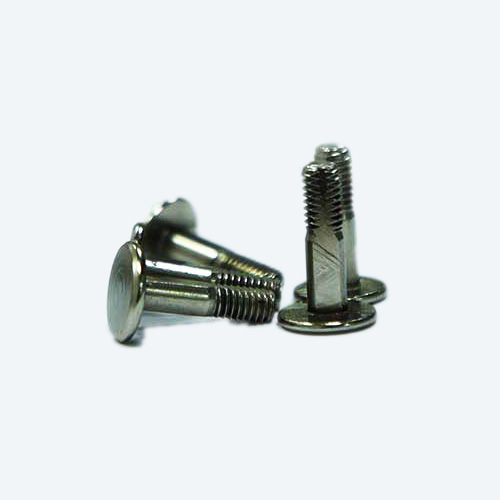


The T-Type Shaft is a precision-engineered mechanical component widely used in electronic products, PCB assemblies, IoT devices, motors, and automation systems. It is designed to provide strong structural locking, excellent vibration resistance, and long service life in compact electronic environments.
| Parameter | Specification |
|---|---|
| Outer Diameter (OD) | M4 – M8 |
| Length | 10.5 – 56 mm |
| Flat Width | 3.2 – 6 mm |
| Material | 65MN / SK5 / SK7 |
| Surface Treatment | Nickel / Chemical Nickel / Zinc / Black Nickel |
| Hardness | HRC36–40 |
| Installation | Standard tools |
| Feature | Vibration-resistant, reusable |
High Structural Stability: T-shaped design improves locking force and prevents loosening in vibration environments.
Excellent Fatigue Resistance: Made of high-carbon spring steel (65MN / SK5 / SK7), suitable for repeated mechanical stress.
Precision Manufacturing: Tight dimensional tolerance ensures stable assembly in electronic systems.
Long Service Life: Heat-treated hardness (HRC36–40) provides durability and wear resistance.
Reusable Design: Can be installed and removed multiple times without deformation.
Wide Compatibility: Suitable for compact electronic devices and industrial automation systems.
Different surface treatments are used to improve corrosion resistance, appearance, and durability depending on application environments.
Nickel Plating: Provides smooth surface finish and strong corrosion resistance. Best for general electronic components and indoor environments.
Chemical Nickel (Electroless Nickel): Offers uniform coating even on complex shapes. Ideal for high-precision electronic assemblies requiring wear resistance and stability.
Zinc Plating: Cost-effective anti-rust protection. Commonly used in standard industrial electronic devices and general machinery parts.
Black Nickel: Provides both corrosion resistance and aesthetic black finish. Used in high-end electronic products and visible structural components.
The T-Type Shaft plays a critical role in modern electronic and precision engineering systems.
PCB Assembly Systems: Ensures alignment stability and reduces mechanical displacement of circuit boards.
Micro Motors: Improves rotation accuracy and reduces vibration in small motor systems.
IoT Devices: Provides compact structural support for smart electronic modules and sensors.
Automation Equipment: Ensures stable motion transmission in compact mechanical systems.
Precision Instruments: Maintains accuracy and reduces external vibration interference.
It significantly improves product reliability, reduces maintenance costs, and enhances long-term stability of electronic systems.
Designed for electronic precision applications
High resistance to vibration and mechanical fatigue
Multiple surface treatment options for different environments
Stable performance under repeated assembly cycles
High compatibility with compact electronic structures
We use 65MN, SK5, and SK7 high-carbon steel materials depending on strength and application requirements.
It provides vibration resistance, structural locking, and stable alignment in electronic and mechanical systems.
It depends on application: nickel for general use, chemical nickel for precision parts, zinc for cost efficiency, and black nickel for high-end products.
Yes, it can be installed and removed multiple times without deformation or performance loss.
It is widely used in PCB systems, motors, IoT devices, automation equipment, and precision instruments.

 English